
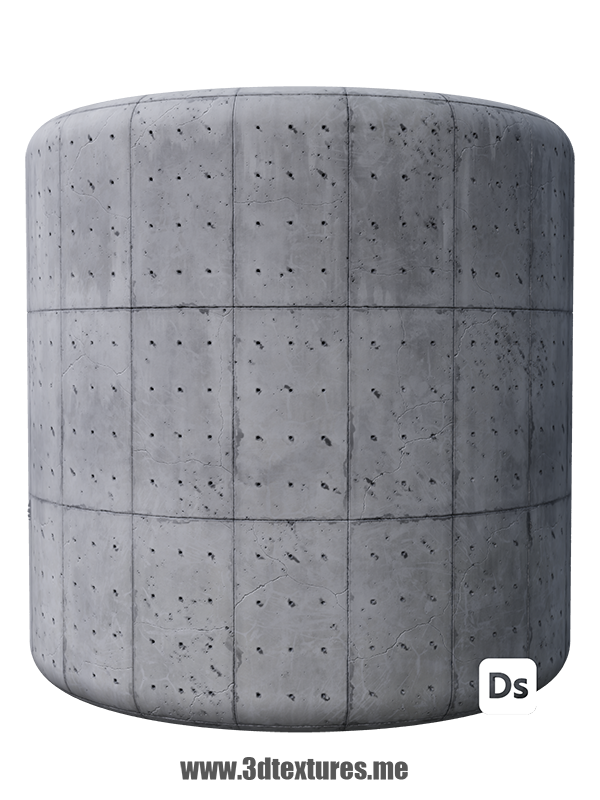
Concrete Wall Formwork 016 is a free seamless PBR texture of board-formed architectural concrete — smooth poured concrete panels divided by vertical formwork seams and horizontal construction joints, with a regular grid of tie holes, fine surface cracking, and the precise, intentional aesthetic of exposed fair-faced concrete.
This is the concrete of Tadao Ando, Le Corbusier, and Paul Rudolph, not rough industrial poured concrete, but the carefully controlled, architecturally considered exposed concrete used in Brutalist and contemporary buildings where the surface itself is the finish. The defining details are all here: the vertical seams where formwork panels met during pouring, the horizontal cold joints between successive concrete pours, the regular dot grid of tie holes left by the formwork bolts, and the subtle surface variation of a material that was liquid and is now permanently set. A few fine shrinkage cracks add age and authenticity without making the surface look damaged. The overall tone is a cool, neutral mid-grey with just enough surface texture to catch raking light dramatically, the quality that makes fair-faced concrete so compelling in both architecture and 3D rendering. One of the most searched concrete types for archviz, game development, and brutalist scene work.
Included Maps
This texture ships with the following PBR maps at 1024 × 1024 px (Patreon Tier 3 unlocks the 4K uncompressed PNG version plus the SBS/SBSAR Substance Designer source files):
- Color (Albedo) – base diffuse color
- Normal – surface micro-detail and depth
- Displacement – geometry-level depth for subdivision or parallax
- Roughness – specular control (matte vs. glossy areas)
- Ambient Occlusion – contact shadows baked into crevices
- ORM (Patreon exclusive) – packed Occlusion/Roughness/Metallic for Unreal Engine. What is an ORM texture?


Engine & Software Compatibility
Drop these maps directly into any PBR-capable software. Tested workflows:
- Blender — connect via the Principled BSDF node. Use Color → Base Color, Normal → Normal Map node → Normal, Roughness → Roughness, Displacement → Displacement node in the material output.
- Unreal Engine 5 — use the ORM map (Patreon) for the packed texture slot, or plug Roughness/Metallic/AO individually into a Material.
- Unity (URP / HDRP) — Color → Albedo, Normal → Normal Map, Roughness → Smoothness (invert the channel).
- Godot 4 — StandardMaterial3D: Albedo → Albedo, Normal → Normal Map, Roughness → Roughness.
- Maya / 3ds Max / Cinema 4D — compatible with Arnold, V-Ray, and Redshift via their PBR shader nodes.

Best Use Cases
Not sure where to apply this texture? Here are some ideas from the community:
- Brutalist and contemporary architectural visualisation — exposed concrete facades, structural walls, stairwells
- Museum, gallery, and cultural building archviz — institutions where fair-faced concrete is a design statement
- Modernist residential interiors — Tadao Ando-inspired concrete feature walls, basement conversions
- Post-apocalyptic and dystopian game environments — bunkers, brutalist city blocks, abandoned facilities
- Sci-fi and near-future game environments — military installations, underground research facilities
- Horror game environments — brutalist architecture’s inherent oppressiveness works naturally for tension-building spaces
- Urban and city environment game levels — car parks, underpasses, infrastructure surfaces
Tiling & Technical Notes
The texture is fully seamless — it tiles without visible seams in any direction. The formwork panel grid and tie hole pattern are designed to repeat naturally, but pay attention to scale: in a real building, formwork panels are typically 60–120cm wide and tie holes are spaced 30–60cm apart. Match your UV scale to these real-world dimensions for architecturally convincing results. For very large concrete walls, a slight UV offset between adjacent wall sections (using Blender’s object coordinates or Unreal’s World-Aligned Texture node) will break up any perception of repeat in the tie hole pattern. The neutral grey albedo responds well to colour grading — a slight warm tint pushes toward sandstone concrete, while desaturation and a blue-grey shift produces a colder, more Nordic character. The color and roughness can be fully modified with the Substance Designer source files available to patrons.
License: CC0 (Public Domain) — free for personal and commercial use, no attribution required. Full license details
You Might Also Like
If you’re working on a similar project, check out these related textures:
- Concrete Blocks 017 — precast concrete block paving for ground and floor surfaces
- Wall Stone 035 — irregular natural stone wall for a rougher, more organic character
- Metal Armor Chainlink 005 — industrial metal surface for brutalist and sci-fi scene layering
Frequently Asked Questions
Can I use this texture in a commercial game or product?
Yes. All textures on 3dtextures.me are released under CC0, which means they are effectively public domain. You can use them in commercial projects without attribution.
What resolution is included for free?
The free download is 1024 × 1024 px. Patreon Tier 3 unlocks 4K (4096 × 4096 px) uncompressed PNGs plus the Substance Designer source files.
How do I download all textures at once?
A bulk download link is available to Ko-Fi supporters and Patrons.
Support on Ko-Fi to receive the folder link.
What is formwork concrete and what are tie holes?
Formwork (or shuttering) is the temporary mould, usually made from wooden or metal panels, into which liquid concrete is poured. Once the concrete sets and the formwork is removed, it leaves the panel seam lines and construction joint marks visible on the surface. Tie holes are the small circular cavities left by the steel bolts that held the two sides of the formwork together during pouring. In architectural concrete, these marks are intentional design features rather than defects, they give fair-faced concrete its characteristic grid pattern.
How do I get realistic tie hole depth?
Use the Displacement map with Adaptive Subdivision in Blender (set displacement scale to 0.02–0.05 for realistic tie hole depth relative to the wall surface). In Unreal Engine 5, Nanite displacement handles this automatically at full geometric detail. For real-time use without tessellation, the Normal and AO maps together give convincing tie hole depth, and enabling Parallax Occlusion Mapping in Blender’s Eevee settings adds a further layer of perceived depth without extra geometry.
What is a seamless / tileable texture?
A seamless texture has matching edges on all four sides, so it can be repeated infinitely across a surface without a visible seam or border. All textures on this site are seamless.
What are SBS / SBSAR files?
These are Substance Designer source files that let you modify the texture parameters colour, roughness, scale, etc.) non-destructively. Available to Patreon supporters.


