
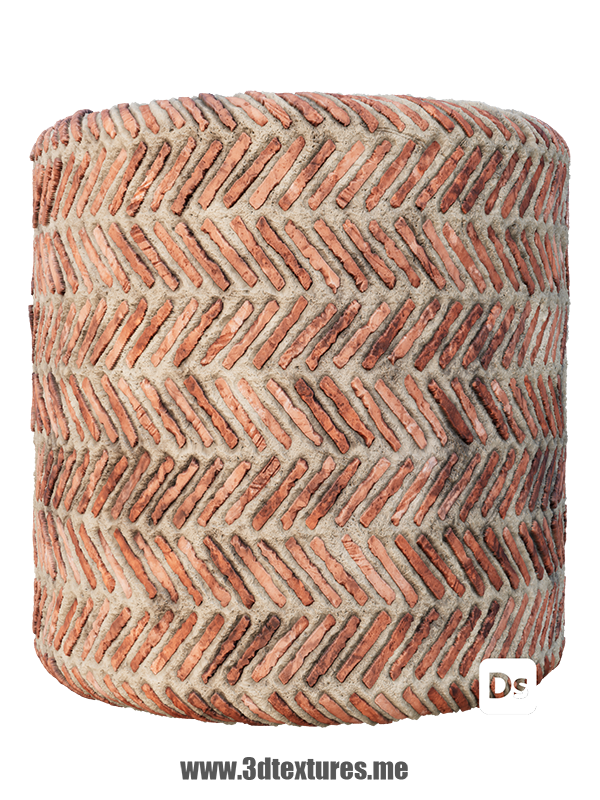
Wall Brick Terracotta 003 is a free seamless PBR texture of handmade terracotta bricks laid in a herringbone (chevron) bond pattern, warm reddish-orange clay bricks set at 45° alternating angles in a dense zigzag arrangement, bedded in thick, sandy, off-white mortar with a coarse, aged texture throughout.
Herringbone bond is one of the oldest and most enduring brick-laying patterns in the world, found in Roman pavements, medieval European castle floors, Ottoman architectural facades, and Portuguese historic building interiors from Lisbon to Porto, and still actively used today in feature walls, garden and courtyard surfaces, and contemporary architectural details. This texture captures that pattern at its most characterful: the bricks are clearly handmade or hand-pressed clay, with each face showing a different surface roughness, subtle warping at the edges, and the warm variation in colour, from deep terracotta to lighter sandy orange, that comes from uneven kiln firing. The mortar joints are thick and textured, with a rough sandy quality that reads as lime mortar rather than smooth modern cement. This is a surface with real age and material honesty in it. The diagonal rhythm of the herringbone creates strong visual interest even at a distance, while the close-up detail of individual bricks rewards proximity. One of the most searched brick bond patterns for archviz, game environment work, and historical scene recreation.
Included Maps
This texture ships with the following PBR maps at 1024 × 1024 px (Patreon Tier 3 unlocks the 4K uncompressed PNG version plus the SBS/SBSAR Substance Designer source files):
- Color (Albedo) – base diffuse color
- Normal – surface micro-detail and depth
- Displacement – geometry-level depth for subdivision or parallax
- Roughness – specular control (matte vs. glossy areas)
- Ambient Occlusion – contact shadows baked into crevices
- ORM (Patreon exclusive) – packed Occlusion/Roughness/Metallic for Unreal Engine. What is an ORM texture?


Engine & Software Compatibility
Drop these maps directly into any PBR-capable software. Tested workflows:
- Blender — connect via the Principled BSDF node. Use Color → Base Color, Normal → Normal Map node → Normal, Roughness → Roughness, Displacement → Displacement node in the material output.
- Unreal Engine 5 — use the ORM map (Patreon) for the packed texture slot, or plug Roughness/Metallic/AO individually into a Material.
- Unity (URP / HDRP) — Color → Albedo, Normal → Normal Map, Roughness → Smoothness (invert the channel).
- Godot 4 — StandardMaterial3D: Albedo → Albedo, Normal → Normal Map, Roughness → Roughness.
- Maya / 3ds Max / Cinema 4D — compatible with Arnold, V-Ray, and Redshift via their PBR shader nodes.

Best Use Cases
Not sure where to apply this texture? Here are some ideas from the community:
- Mediterranean and Southern European architectural visualisation: Portuguese, Spanish, Italian and Greek historic buildings and courtyards
- Historical and period game environments: Roman villas, medieval city streets, Ottoman and Moorish architecture, Renaissance European town interiors
- Feature walls and garden surfaces in contemporary residential archviz: herringbone bond is increasingly used as a decorative exterior and interior finish
- Fantasy and RPG game environments: ancient ruins, temple interiors, village market squares, tavern floor and wall surfaces
- Archaeological site renders: Roman and early medieval brick structures where herringbone bond is historically documented
- Courtyard and exterior ground surfaces: the herringbone pattern reads equally well horizontally as a paving texture
- Interior design visualisation: feature walls in residential, hospitality, and retail spaces where warm material texture is part of the design language
Tiling & TEchnical Notes
The texture is fully seamless, it tiles without visible seams in any direction. The herringbone pattern is designed to repeat naturally, but because the 45° diagonal creates a strong visual rhythm, pay particular attention to scale: real herringbone brick courses use standard brick sizes, typically 210 × 100 × 65 mm, which means the diagonal unit of the pattern is approximately 300 mm wide. Match your UV scale to these real-world dimensions for architecturally convincing results. For very large wall or floor surfaces, applying a slight UV offset or rotation between adjacent mesh sections will break up any perception of regular repeat. The herringbone orientation also makes this texture work surprisingly well rotated 90°, the zigzag pattern remains coherent and creates a slightly different visual character. The warm terracotta albedo is easy to colour grade: a slight desaturation and hue shift toward brown-grey produces a more aged, weathered character, while pushing toward a deeper red-orange gives a more freshly fired look.
The color and roughness can be fully modified with the Substance Designer source files available to patrons.
License: CC0 (Public Domain) — free for personal and commercial use, no attribution required. Full license details
You Might Also Like
If you’re working on a similar project, check out these related textures:
-
- Wall Brick Terracotta 001 – irregular handmade terracotta bricks in a standard bond for a more rustic, varied surface
- Wall Brick Terracotta 002 – warmer terracotta brick in running bond for Mediterranean and historical scenes
- Wall Brick 027 – white-painted thin Roman-format brick with a contemporary Mediterranean character
Frequently Asked Questions
Can I use this texture in a commercial game or product?
Yes. All textures on 3dtextures.me are released under CC0, which means they are effectively public domain. You can use them in commercial projects without attribution.
What resolution is included for free?
The free download is 1024 × 1024 px. Patreon Tier 3 unlocks 4K (4096 × 4096 px) uncompressed PNGs plus the Substance Designer source files.
How do I download all textures at once?
A bulk download link is available to Ko-Fi supporters and Patrons.
Support on Ko-Fi to receive the folder link.
What is a seamless / tileable texture?
A seamless texture has matching edges on all four sides, so it can be repeated infinitely across a surface without a visible seam or border. All textures on this site are seamless.
What are SBS / SBSAR files?
These are Substance Designer source files that let you modify the texture parameters colour, roughness, scale, etc.) non-destructively. Available to Patreon supporters.


