
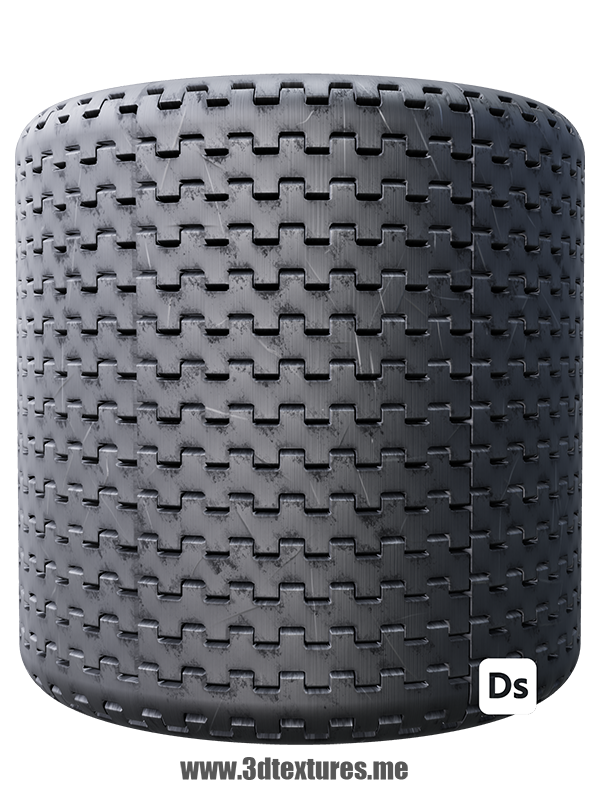
Conveyor Belt 001 is a free seamless PBR texture of a modular interlocking metal conveyor belt, dark charcoal steel links with a distinctive T-slot and tab pattern, surface scratches from continuous use, and the worn matte sheen of heavy industrial metal that has been running under load for a very long time.
This is the conveyor belt of bottling plants, mining operations, airport baggage systems, and logistics warehouses, not a simple flat band, but a precision-engineered modular belt made of interlocking steel links. Each link connects to its neighbours through a T-slot and tab joint, creating the characteristic repeating geometry of a modular metal conveyor system. The surface tells the story of working machinery: fine longitudinal scratches from contact with transported goods, slight variation in sheen across the link surface where the metal flexes and wears unevenly, and the occasional deeper mark from something hard passing through. The overall colour is a deep, slightly warm charcoal, dark enough to read as bare or coated industrial steel but with enough surface variation to avoid flatness under raking light. Highly searched for factory interiors, industrial game environments, and mechanical archviz scenes where believable working machinery is essential.
Included Maps
This texture ships with the following PBR maps at 1024 × 1024 px (Patreon Tier 3 unlocks the 4K uncompressed PNG version plus the SBS/SBSAR Substance Designer source files):
- Color (Albedo) – base diffuse color
- Normal – surface micro-detail and depth
- Displacement – geometry-level depth for subdivision or parallax
- Roughness – specular control (matte vs. glossy areas)
- Ambient Occlusion – contact shadows baked into crevices
- Metallic – PBR metal/dielectric mask (metallic for the bare steel link surfaces, slightly lower in worn coating areas)
- ORM (Patreon exclusive) – packed Occlusion/Roughness/Metallic for Unreal Engine. What is an ORM texture?


Engine & Software Compatibility
Drop these maps directly into any PBR-capable software. Tested workflows:
- Blender — connect via the Principled BSDF node. Use Color → Base Color, Normal → Normal Map node → Normal, Roughness → Roughness, Displacement → Displacement node in the material output.
- Unreal Engine 5 — use the ORM map (Patreon) for the packed texture slot, or plug Roughness/Metallic/AO individually into a Material.
- Unity (URP / HDRP) — Color → Albedo, Normal → Normal Map, Roughness → Smoothness (invert the channel).
- Godot 4 — StandardMaterial3D: Albedo → Albedo, Normal → Normal Map, Roughness → Roughness.
- Maya / 3ds Max / Cinema 4D — compatible with Arnold, V-Ray, and Redshift via their PBR shader nodes.

Best Use Cases
Not sure where to apply this texture? Here are some ideas from the community:
- Factory and manufacturing archviz: production lines, packaging machinery, assembly plant floors
- Logistics and warehouse environments: sorting systems, distribution centre game levels, airport baggage claim areas
- Mining and quarry game environments: ore transport belts, underground facility conveyor systems
- Post-apocalyptic and industrial game levels: derelict factories, abandoned warehouses, ruined machinery
- Sci-fi and near-future environments: automated assembly plants, robotic manufacturing bays, space station cargo systems
- Food industry and processing plant archviz: bottling lines, packaging systems, cold storage conveyor runs
- Props and machinery detail work: close-up shots of working or broken conveyor belt segments as hero assets
Tiling & Technical Notes
The texture is fully seamless, it tiles without visible seams in any direction. The interlocking link pattern is designed to repeat naturally along both axes, but pay attention to real-world scale: in a standard modular metal conveyor belt, individual links are typically 25-50mm wide and the T-slot pitch is 20-40mm. Scale your UVs to match these dimensions for mechanically convincing proportions. The texture tiles correctly in the belt travel direction, making it well-suited for UV-scrolling animation to simulate belt movement. For very wide conveyor surfaces, a slight UV offset between adjacent belt sections will prevent any repetition in the scratch pattern from reading as artificial. The deep charcoal albedo holds well in both daylit and artificial factory lighting, a cool overhead fluorescent or industrial LED setup is particularly effective for this material, letting the metallic response and Normal map geometry do the work.
License: CC0 (Public Domain) — free for personal and commercial use, no attribution required. Full license details
You Might Also Like
If you’re working on a similar project, check out these related textures:
- Metal Plate 049 — weathered red-painted industrial steel plating for factory walls, storage tanks, and machinery housings
- Metal Grill 026 — interlocked galvanized steel grill for industrial walkways, safety cages, and machine guards
- Chainmail 001 — interlocking metal ring pattern for mechanical mesh surfaces and industrial armour details
Frequently Asked Questions
Can I use this texture in a commercial game or product?
Yes. All textures on 3dtextures.me are released under CC0, which means they are effectively public domain. You can use them in commercial projects without attribution.
What resolution is included for free?
The free download is 1024 × 1024 px. Patreon Tier 3 unlocks 4K (4096 × 4096 px) uncompressed PNGs plus the Substance Designer source files.
How do I download all textures at once?
A bulk download link is available to Ko-Fi supporters and Patrons.
Support on Ko-Fi to receive the folder link.
What is a seamless / tileable texture?
A seamless texture has matching edges on all four sides, so it can be repeated infinitely across a surface without a visible seam or border. All textures on this site are seamless.
What are SBS / SBSAR files?
These are Substance Designer source files that let you modify the texture parameters colour, roughness, scale, etc.) non-destructively. Available to Patreon supporters.


