
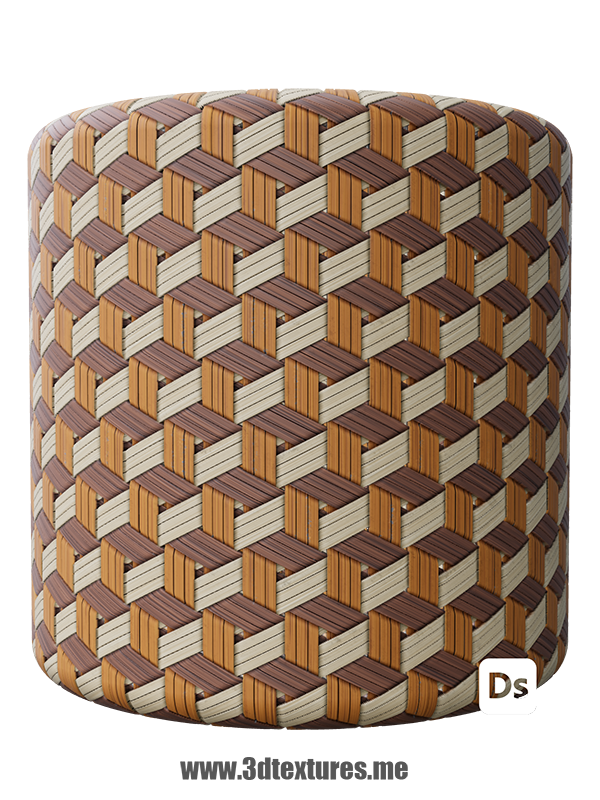
Wood Wicker 013 is a free seamless PBR texture of a diagonal flat-strip basket weave, wide wicker bands interlaced at 45° in a rich three-tone palette of natural cream, warm amber, and dark chocolate brown, with deep physical geometry between each crossing strip.
Where most wicker textures use round strands and a simple over-under rhythm, this one is built around wide, flat wicker bands woven in a bold diagonal herringbone pattern, three strips running in one direction crossing three strips running the other, creating the characteristic angled diamond geometry of a handcraft basket weave. The tri-color palette gives it an unmistakably decorative character: the natural cream of undyed rattan, the warm amber of lightly stained wood strips, and the deep chocolate of a darker finish, all interlocking in a tight, repeating geometry that catches light dramatically at the crossover points. The Displacement and Normal maps carry real depth at each weave crossing, this is not a flat print texture, but one with genuine three-dimensional relief that rewards close camera work and raking light. An excellent choice for any interior or lifestyle scene that needs authentic handcraft warmth, from Bohemian living rooms to mid-century rattan furniture and tropical resort environments.
Included Maps
This texture ships with the following PBR maps at 1024 × 1024 px (Patreon Tier 3 unlocks the 4K uncompressed PNG version plus the SBS/SBSAR Substance Designer source files):
- Color (Albedo) – base diffuse color
- Normal – surface micro-detail and depth
- Displacement – geometry-level depth for subdivision or parallax
- Roughness – specular control (matte vs. glossy areas)
- Ambient Occlusion – contact shadows baked into crevices
- Opacity
- ORM (Patreon exclusive) – packed Occlusion/Roughness/Metallic for Unreal Engine. What is an ORM texture?


Engine & Software Compatibility
Drop these maps directly into any PBR-capable software. Tested workflows:
- Blender — connect via the Principled BSDF node. Use Color → Base Color, Normal → Normal Map node → Normal, Roughness → Roughness, Displacement → Displacement node in the material output.
- Unreal Engine 5 — use the ORM map (Patreon) for the packed texture slot, or plug Roughness/Metallic/AO individually into a Material.
- Unity (URP / HDRP) — Color → Albedo, Normal → Normal Map, Roughness → Smoothness (invert the channel).
- Godot 4 — StandardMaterial3D: Albedo → Albedo, Normal → Normal Map, Roughness → Roughness.
- Maya / 3ds Max / Cinema 4D — compatible with Arnold, V-Ray, and Redshift via their PBR shader nodes.

Best Use Cases
Not sure where to apply this texture? Here are some ideas from the community:
- Boho and mid-century interior archviz: wicker chairs, pendant lamp shades, storage baskets, headboards
- Tropical and resort environment rendering: beach cabana walls, poolside furniture, thatched pavilion interiors
- Craft and lifestyle product visualisation: wicker trays, decorative bowls, hamper baskets
- Game environment props: tavern and village market items, rustic storage containers, ethnic interior set dressing
- Stylised game environments: the bold diagonal pattern reads clearly even at lower texture resolutions and viewing distances
- E-commerce and product CGI: lifestyle backdrop surfaces and prop texturing for home goods advertising
- Fashion and accessory rendering: wicker bag surface, hat brim detail, woven footwear material
Tiling & Technical Notes
The texture is fully seamless, it tiles without visible seams in any direction. The diagonal weave repeat has a strong 45° rhythm; on large surfaces this is best managed by alternating UV rotation between adjacent panels (45° or 90° offsets) to suggest natural variation in the weave direction without requiring a unique texture. For real-world UV scaling, aim for approximately 2-4 cm per strip width on furniture-scale objects and 5-8 cm on architectural wicker wall panels. The three-tone colour split (cream / amber / brown) is baked into the albedo map and can be tinted globally via a Hue-Saturation node, push all three tones toward grey for a bleached sun-faded look, or add warmth for freshly lacquered rattan. Because the weave crossing points generate strong AO even without displacement, this texture performs well in real-time contexts where displacement is disabled, retaining convincing depth through the Normal and AO maps alone.
License: CC0 (Public Domain) — free for personal and commercial use, no attribution required. Full license details
You Might Also Like
If you’re working on a similar project, check out these related textures:
- Wood Wicker 012 – a different wicker weave style for more variety in the same series
- Wood Wicker 011 – another seamless PBR wicker pattern for furniture and interior props
- Bamboo Weave 001 – flat bamboo strip weave for a lighter, greener organic material
Frequently Asked Questions
Can I use this texture in a commercial game or product?
Yes. All textures on 3dtextures.me are released under CC0, which means they are effectively public domain. You can use them in commercial projects without attribution.
What resolution is included for free?
The free download is 1024 × 1024 px. Patreon Tier 3 unlocks 4K (4096 × 4096 px) uncompressed PNGs plus the Substance Designer source files.
How do I download all textures at once?
A bulk download link is available to Ko-Fi supporters and Patrons.
Support on Ko-Fi to receive the folder link.
What is a seamless / tileable texture?
A seamless texture has matching edges on all four sides, so it can be repeated infinitely across a surface without a visible seam or border. All textures on this site are seamless.
What are SBS / SBSAR files?
These are Substance Designer source files that let you modify the texture parameters colour, roughness, scale, etc.) non-destructively. Available to Patreon supporters.


